

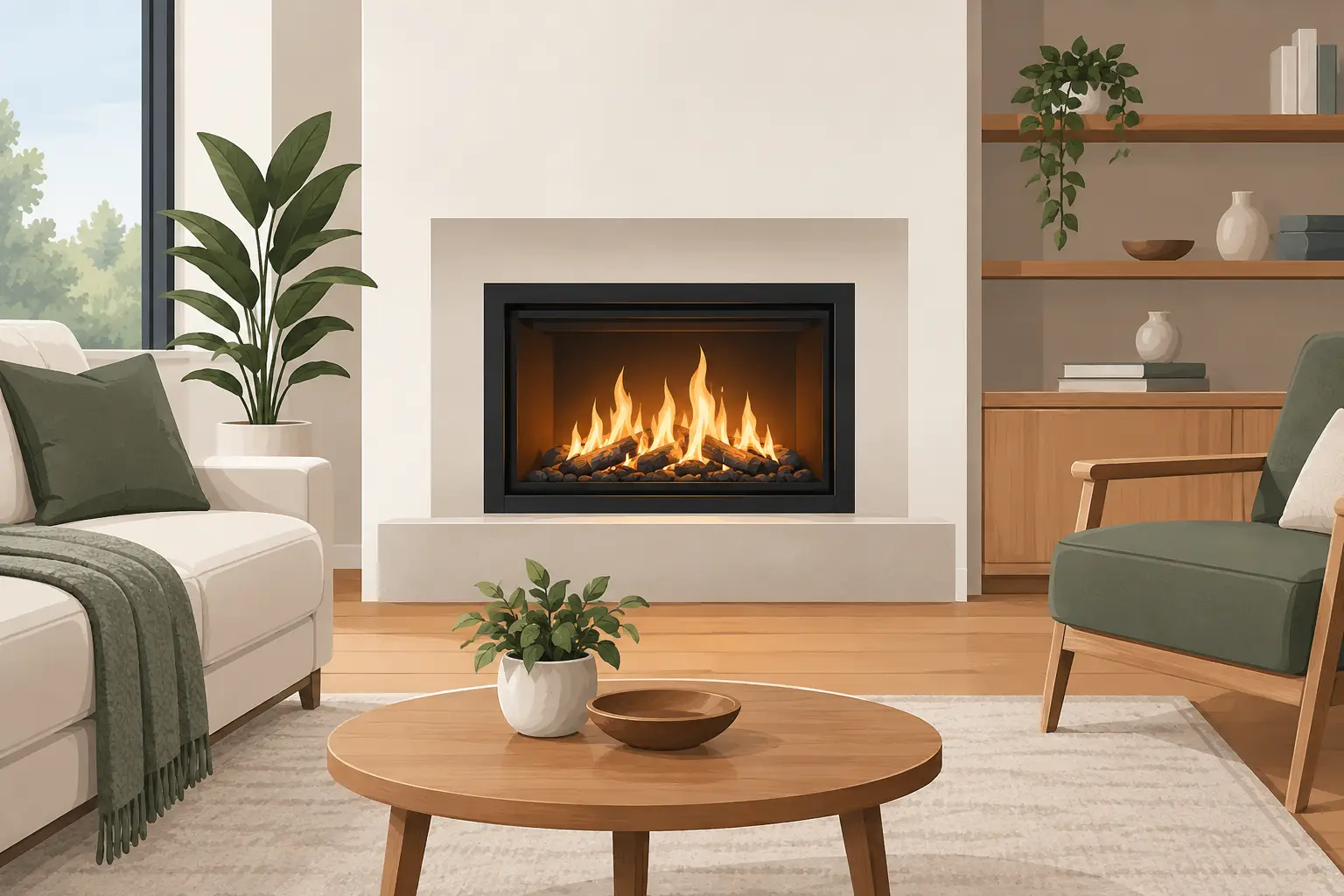
A gas fire that looks perfect in the showroom can feel very different once it is installed at home. Too little heat and the room never feels properly comfortable. Too much and you may find yourself turning the fire down or opening a window. Sizing gas fires correctly means matching the appliance to your room, the way you use it and the practical requirements of your property.
It is not simply a matter of choosing the highest kilowatt rating available. A well-chosen gas fire should provide pleasant, controllable warmth, suit the style of the room and be installed safely by a suitably qualified engineer. For many homeowners, a short conversation and a proper survey prevent the costly mistake of buying a fire that is either underpowered or unnecessarily powerful.
Why heat output matters when choosing a gas fire
The heat output of a gas fire is measured in kilowatts, usually shown as kW. This indicates how much useful heat the appliance can provide to the room. It is different from gas input, which is the amount of fuel the fire uses. When comparing models, the useful heat output is the figure that matters most for comfort.
A small, well-insulated lounge may only need a modest output to feel warm. A larger period property with high ceilings, single glazing or draughty doors can need considerably more. The same fire can therefore be ideal in one house and unsuitable in another.
Choosing more output than you need is not always a benefit. An oversized fire can make the room uncomfortably hot before you have had the chance to enjoy the flame effect. It may also spend much of its life operating at a low setting, which is not necessarily the experience you had in mind when selecting a feature fire for the heart of your home.
On the other hand, a fire that is too small may look attractive but struggle on colder evenings. It can still be useful as a focal point or supplementary heat source, but it should not be expected to do a job beyond its intended capacity.
Sizing gas fires correctly starts with the room
The dimensions of the room provide a sensible starting point. As a broad guide, installers consider the room’s length, width and ceiling height to establish its volume. A larger volume of air requires more heat, but that is only part of the calculation.
Ceiling height is particularly easy to overlook. Many homes have standard-height ceilings, while others have vaulted spaces, extensions or older rooms with generous proportions. A fire selected purely on floor area can be undersized if there is much more air above head height to warm.
You should also consider whether the room is open plan. A fire in a lounge that opens into a kitchen, dining area or hallway will lose heat into those adjoining spaces. Even when doors are usually shut, wide openings can change how the room feels on a cold evening. In these settings, a larger output may be appropriate, although the layout, insulation and intended use all need to be assessed together.
A simple rule-of-thumb calculation can offer an initial indication, but it should never replace advice from an experienced installer. Modern insulation standards, building materials, glazing, external walls and even the direction a room faces can alter the final recommendation.
Insulation changes the answer
Two rooms of the same size can have very different heating needs. A recently improved room with loft insulation, efficient glazing and a well-sealed external door will retain heat much better than an older room with noticeable draughts.
Solid-wall properties, conservatories and rooms above garages may lose heat faster than the rest of the house. Equally, a south-facing room that benefits from daytime sunshine may not need the same output as a north-facing sitting room used mostly in the evening.
This is why honest advice matters. Rather than selecting a fire from a specification sheet alone, it is better to discuss how warm the room currently feels, whether it is heated by radiators as well and when you are most likely to use the fire.
Decide whether the fire is primary or additional heating
A gas fire can play different roles in different homes. In some properties it is the main source of warmth in the living room. In others, central heating does most of the work and the fire is used for extra comfort, atmosphere and quick warmth on chilly evenings.
If the gas fire will be your principal heat source in the room, correct output becomes more critical. It needs enough capacity to take the chill off and maintain a comfortable temperature without working at full power constantly.
If it is supplementary heating, you may have more flexibility. A lower-output fire can be a very sensible choice where radiators already heat the space effectively, especially if your priority is a realistic flame picture, a contemporary hole-in-the-wall look or a traditional fireplace setting.
Think about your normal routine, not only the coldest day of the year. A family room used every evening has different demands from a formal lounge used occasionally. The right choice should be comfortable for everyday living, not just impressive on paper.
The type of gas fire affects suitability
Gas fires are available in several formats, and the installation route can influence which output and style are suitable for your home. Conventional flue fires use a chimney or flue to take combustion products safely outside. Balanced flue fires are designed for properties without a conventional chimney and draw air from outside through their flue system.
Flueless gas fires have their own requirements, including room-size and ventilation considerations. They are not suitable for every property or every household. A Gas Safe registered engineer can assess whether this type of appliance is appropriate and explain the ventilation provisions needed.
The opening, chimney condition and surrounding materials also matter. An existing fireplace may need preparation before a new fire can be fitted. A modern media wall or inset installation needs suitable clearances, the correct construction and a fire designed for that application. The most attractive design is only the right choice when it can be installed safely and in line with the manufacturer’s instructions.
Do not judge output by flame size alone
A wide fire with an impressive flame display is not automatically the hottest option, and a compact inset model is not necessarily weak. Modern gas fires vary greatly in their design, efficiency and control systems.
Some fires offer a broad range of heat settings, allowing you to reduce output once the room is warm. Others are intended mainly for visual impact and gentle supplementary heating. Looking at both the maximum and minimum heat output helps you understand how flexible a model will be through the seasons.
Efficiency is worth considering too, particularly if the fire will be used regularly. A more efficient appliance converts a greater proportion of the gas it uses into usable room heat. However, efficiency should sit alongside the correct size, installation requirements and the appearance you want. There is rarely one figure that decides the best fire for every home.
A professional survey gives you a clearer answer
Before committing to a gas fire, a site survey is the sensible next step. This gives an installer the chance to assess the room, existing chimney or flue, ventilation, hearth, fireplace opening and the route for any new flue system. They can also check gas supply arrangements and confirm whether the chosen model is compatible with the proposed installation.
This is especially valuable when replacing an older gas fire. Older appliances and openings do not always meet current requirements, and a like-for-like replacement may not be as straightforward as it first appears. A survey makes sure the recommendation is based on the property as it stands now, rather than assumptions.
At Wirral Fires, customers can view different styles in person and discuss what they need without pressure before arranging professional installation. Seeing the flame effect, trim options and proportions of a fire often makes it easier to narrow down the right model.
Questions worth considering before you choose
It helps to have a few details ready when you visit a showroom or speak to an installer. Know the approximate room dimensions, ceiling height, whether the space is open plan and how the room is currently heated. If there is an existing fireplace, photographs and basic information about the chimney or current appliance can also be useful.
Be clear about what you want the fire to achieve. Are you looking to heat a frequently used lounge, add warmth to a renovated dining room, or create a focal point in a space already served by central heating? There is no wrong answer, but the answer affects the best output and type of appliance.
A correctly sized gas fire should feel like a natural part of the room: warm enough when you need it, controllable when you do not, and fitted with the care that a gas appliance deserves. Taking time to assess the room before choosing will leave you with a fire that looks right, performs well and remains a pleasure to use for years to come.