

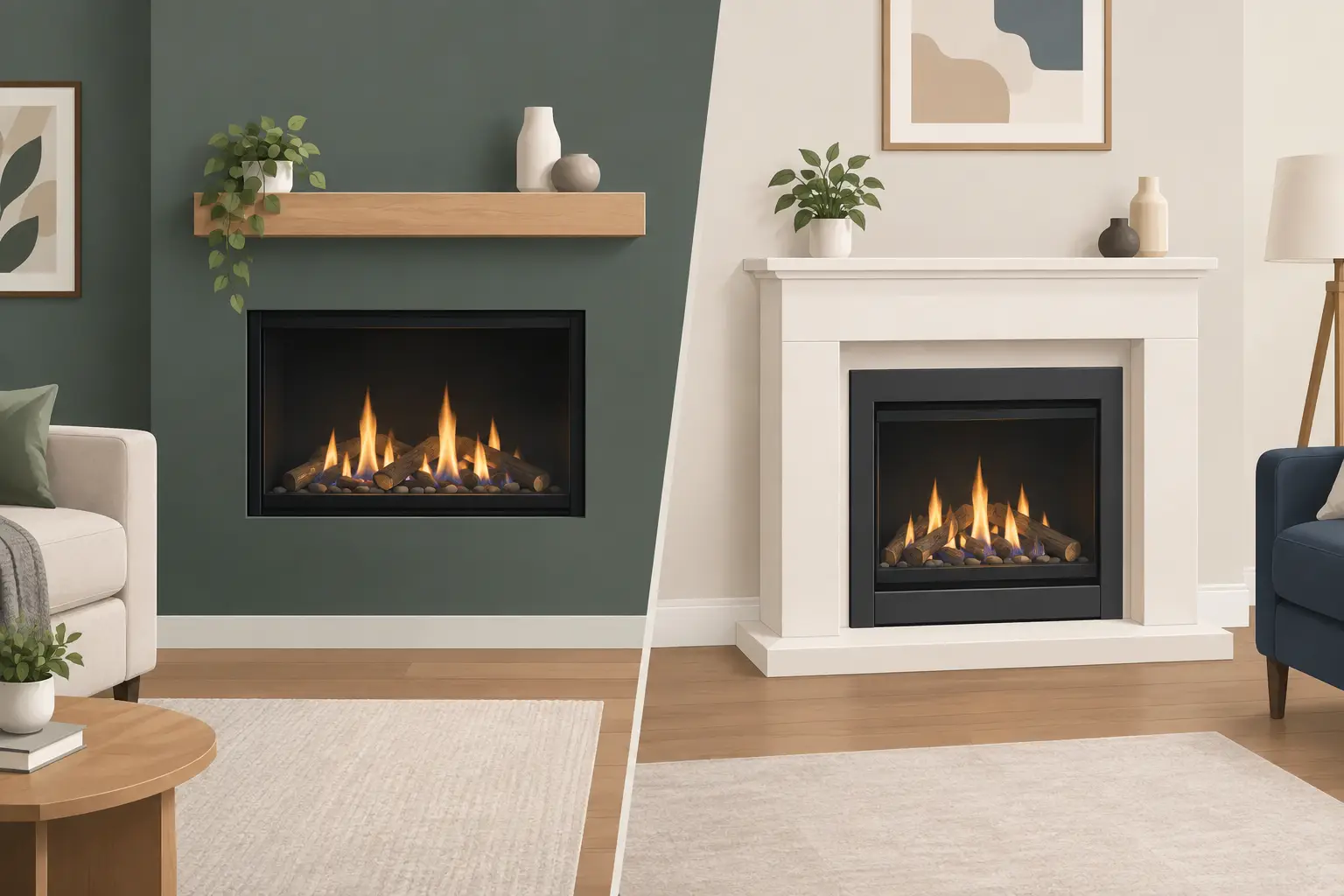
A gas fire can change the feel of a living room in an instant, but the right choice starts well before you choose a flame effect or surround. When comparing inset versus outset gas fires, the key difference is how the appliance sits within the room – and that affects the look, installation options, heat delivery and the space it takes up.
An inset fire is recessed into a fireplace opening or purpose-made recess. An outset fire projects into the room, sitting in front of the chimney breast or wall. Neither is automatically the better option. The best fit depends on your property, your existing fireplace, the room you want to heat and the finish you have in mind.
What is an inset gas fire?
An inset gas fire is designed to sit back into a fireplace opening, leaving the front of the fire flush or almost flush with the surround. It is the familiar choice for many homes with a traditional chimney breast, particularly where a homeowner wants to retain the classic fireplace arrangement of fire, hearth and mantel.
Because much of the appliance is housed within the opening, an inset fire can give a neat, built-in appearance without taking too much floor space. This makes it a strong option for smaller lounges, narrow chimney breasts and rooms where furniture needs to sit relatively close to the fireplace.
Inset models are available in traditional and contemporary styles. Some have an open-front design with a realistic coal or pebble fuel bed, while others are glass-fronted for a more modern appearance. The choice matters: a glass-fronted gas fire will often retain more heat in the room, but the exact heat output and efficiency always depend on the individual model and the way it is installed.
When an inset fire makes sense
An inset gas fire is often suitable when you have a usable chimney opening and want the fire to feel like part of the fireplace rather than a feature standing in front of it. It can work especially well with a new surround and hearth package, allowing the whole fireplace to be planned around the proportions of the room.
That said, not every existing opening is suitable without alteration. The depth, width and condition of the recess all matter. Older properties can have awkward dimensions, while some newer homes have shallow pre-cast flues that only accept specific fires. A proper survey removes the guesswork before you commit to a style.
What is an outset gas fire?
An outset gas fire sits forward of the wall rather than being deeply recessed into it. It has a more visible body and can make a stronger statement in the room. Some styles are traditional and substantial, while others have clean lines that suit a more contemporary fireplace design.
The main benefit is flexibility where recess depth is limited. If your chimney opening is too shallow for a standard inset appliance, or you would rather avoid extensive building work, an outset model may be a practical solution. It can also be a good way to create a fireplace focal point where the existing opening is not particularly attractive or useful.
Outset fires generally take up more visual and physical space than inset designs. That is not necessarily a drawback. In a larger room, the extra presence can help the fireplace feel properly proportioned, particularly when paired with a wider surround or a bold hearth.
When an outset fire makes sense
Consider an outset gas fire if you like the look of a more prominent appliance, have a shallow recess, or want to minimise changes to the chimney breast. They can be particularly effective in period-style rooms, where a more substantial fire complements traditional furnishings and a larger mantel.
You do need to allow for the projection into the room. Measure the hearth area, walking routes and the position of sofas or coffee tables rather than judging from photographs alone. A fire that looks compact in a showroom can feel very different once it is placed beneath your own chimney breast.
Inset versus outset gas fires: the practical differences
The visual difference is easy to spot, but the practical considerations are usually what decide the matter. The first is available depth. An inset fire needs enough room behind the front fascia for the firebox and flue arrangement. An outset fire needs less recess depth but requires clear space in front of the wall.
The second is fireplace design. Inset fires tend to suit a streamlined, contained look, particularly with a simple surround. Outset fires provide more presence and can suit a room where the fireplace is intended to be a central design feature. Neither style has to be old-fashioned or ultra-modern – the surround, hearth, trim and fuel bed play a major part in the finished look.
Heat is another important consideration, but it is not as simple as saying one type is always warmer. Heat output, efficiency and how the warmth is directed into the room vary from one appliance to another. Open-front fires offer a very traditional appearance, while glass-fronted fires are commonly chosen by homeowners who want to make better use of the heat produced. The right output should be based on the room size, insulation, ceiling height and how you use the space.
Your chimney, flue and ventilation matter
Before choosing either type of gas fire, the property needs to be assessed for a suitable flue route and safe installation. Homes may have a conventional chimney, a pre-cast flue, a balanced flue system or, in some cases, an option designed for use without a chimney. Each has different requirements, and not every gas fire can be fitted to every flue type.
A conventional chimney often gives the widest selection, but its condition still needs checking. A pre-cast flue is more restrictive because of its shallower construction. Balanced flue fires can be a useful choice in properties without a traditional chimney, but they require an appropriate external wall position for the flue terminal.
Ventilation requirements also vary by appliance and room. It is never sensible to block or remove an air vent simply because it feels draughty. A Gas Safe registered engineer can advise on the correct fire type, flue suitability and any ventilation needed to keep the installation safe and compliant.
Think about the whole fireplace, not just the fire
A gas fire rarely stands alone. The hearth, surround and mantel will influence whether an inset or outset model looks at home in the room. With an inset fire, a slimline surround can keep the finish tidy and understated. With an outset fire, a deeper hearth and a more substantial surround may help the proportions feel balanced.
Material choices matter too. A pale stone-effect surround can brighten a darker room, while a darker finish can give a more defined focal point. If you are renovating the entire living space, take a sample of flooring, paint or wallpaper to the showroom. Seeing finishes side by side is far more reliable than making a decision from an image on a phone.
For households with children or pets, consider the hearth projection and where people naturally walk through the room. All gas fires need sensible use and supervision, but careful planning can make the finished fireplace feel more comfortable to live with day to day.
Why a home survey is worthwhile
It is tempting to select a fire based on appearance first, especially when you have found a style you love. However, a home survey should come before the final decision. It confirms the opening size, chimney or flue type, gas supply position, hearth requirements and any work needed for a safe, neat installation.
It also gives you the chance to discuss what you actually want from the fire. Is it mainly a welcoming focal point for evenings at home, a useful source of warmth in the lounge, or both? Do you want a traditional coal-effect fire, or a cleaner contemporary finish? Clear answers help narrow the range without pressure or confusion.
At Wirral Fires, our experienced team can talk through the options in person and arrange professional installation by Gas Safe registered engineers. It is a straightforward way to make sure the fire you choose suits both your room and your property.
The most satisfying fireplace projects are not necessarily the ones with the largest fire or the boldest surround. They are the ones where the proportions feel right, the warmth suits the room and you can enjoy the flame knowing the installation has been properly considered.