

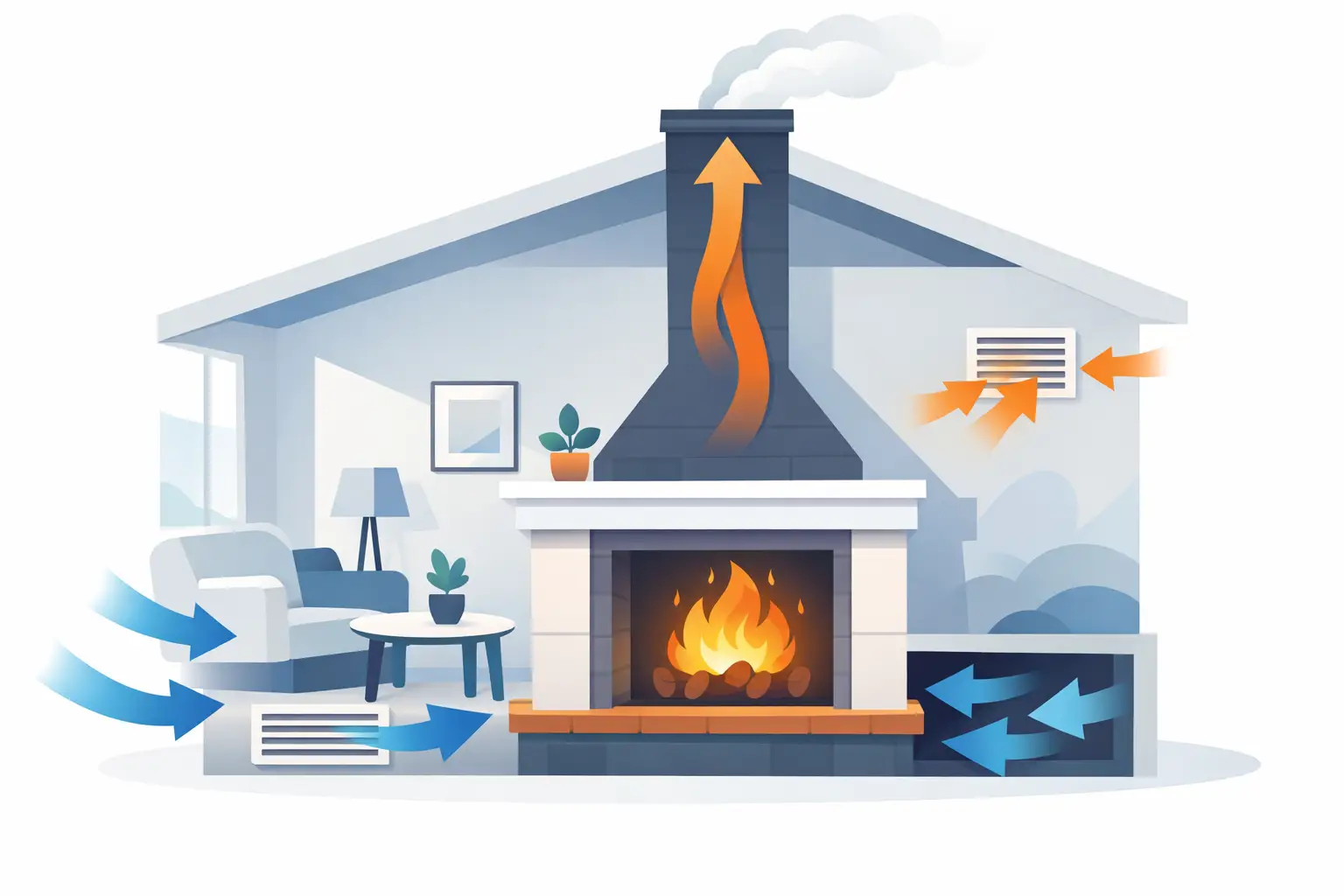
A beautiful fire should make a room feel more comfortable, not leave you wondering whether it has been fitted safely. Fireplace ventilation requirements are one of the first things to consider when choosing a gas fire, stove, wood burner or open fire. They affect the appliance you can have, the way it performs and, most importantly, how safely it operates in your home.
Ventilation is not simply a case of adding an air brick because there is a fireplace. The right solution depends on the type of appliance, its heat output, the flue arrangement, the age and airtightness of the property, and the manufacturer’s installation instructions. A proper survey takes all of these details into account before any fitting work begins.
Why fireplace ventilation matters
Every fuel-burning appliance needs oxygen to burn efficiently. If there is not enough permanent air entering the room, combustion can become poor and the fire may struggle to draw correctly. This can lead to smoke or fumes entering the room, soot staining around the opening, a weak flame or difficulty keeping a stove alight.
Gas fires, wood burners, multi-fuel stoves and open fires all remove combustion gases through a flue or chimney. As those gases leave the home, replacement air must be able to enter. Where this balance is disrupted, the flue can lose its draw or even reverse it. This is known as spillage or back-draughting, and it is a clear safety concern.
Modern homes can make this more complicated. Draught-proof windows, sealed doors, insulation upgrades and extractor fans all improve comfort and energy efficiency, but they also reduce the natural air leakage that older houses often had. That does not mean a new fire cannot be installed. It does mean ventilation needs closer attention.
Fireplace ventilation requirements by fire type
The appliance instructions and current building requirements always take priority, but understanding the broad differences can help you plan with confidence.
Open fires
An open fire has the greatest appetite for air because a large volume of warm air travels up the chimney while it is burning. Many open fires require a dedicated source of permanent ventilation, particularly where the room is well sealed or the fire opening is substantial.
An air vent may be positioned through an external wall, beneath a suspended timber floor or, in some cases, through another suitable route. It should not be blocked, covered by furniture or fitted with a closable grille. The airflow can feel noticeable on colder days, which is one reason some homeowners choose a stove or a high-efficiency gas fire instead of retaining a fully open fire.
Wood-burning and multi-fuel stoves
A stove is enclosed, so it generally uses less room air than an open fire. However, many stoves still need dedicated permanent ventilation depending on their rated output and the property. The exact free-air area is calculated from the appliance specification and installation guidance, not guessed from the size of the room.
Some newer stoves are designed to take combustion air directly from outside through a dedicated external air supply. This can be a particularly sensible option in well-insulated homes, as it reduces reliance on air being drawn from the living space. It can also help avoid cold draughts from a conventional wall vent, although suitability depends on the stove and the installation layout.
A wood burner also needs a chimney or flue system that is correctly sized, sound and suitable for the appliance. Ventilation and flue performance work together. A good-quality liner will not solve a lack of air supply, and an air vent cannot compensate for a poorly designed flue.
Gas fires and gas stoves
Gas fire ventilation requirements vary considerably. Some gas fires use an existing chimney, some use a balanced flue through an outside wall, and others are designed for chimney-free installation where permitted. Each type has very different conditions.
A conventional flued gas fire often draws air from the room and sends products of combustion up the chimney or flue. Depending on its type, input and manufacturer instructions, it may require permanent ventilation. A balanced flue gas fire is room-sealed, taking combustion air from outside and returning combustion gases outside through its dedicated flue terminal. This design can be a strong option where there is no usable chimney, but it still requires careful consideration of terminal position and clearances.
Chimney-free gas fires have their own specific requirements for room volume and ventilation. They are not suitable for every property or every household. Because gas appliances must be installed and checked by a Gas Safe registered engineer, professional advice is essential before making a decision.
Electric fires
Electric fires do not burn fuel and do not produce combustion gases, so they do not require a chimney, flue or permanent combustion ventilation. This makes them a flexible choice for media walls, bedrooms, extensions and homes where a solid-fuel or gas installation is impractical.
That said, an electric fire still needs to be installed in line with its electrical and ventilation clearances. Heat outlets must not be obstructed, and the surrounding furniture or finish needs to be suitable for the appliance. These are simpler considerations, but they still matter for safe, reliable use.
The chimney, flue and air supply must be considered together
It is tempting to focus only on the fire itself, especially when choosing a style or surround. In practice, the chimney and the room are just as important. A chimney may need sweeping, testing, lining or repairing before it is ready for a new appliance. Some older chimneys are too large for a modern stove without a liner, while others may have leaks or restrictions that affect draw.
Extractor fans can also influence performance. Kitchen cooker hoods, bathroom fans and utility-room extractors remove air from the house. In a tightly sealed property, running a powerful extractor near a live fire may create negative pressure and interfere with the flue. During a survey, it is worth mentioning any planned renovation work, replacement windows or mechanical ventilation systems, not just the fireplace opening.
Where should an air vent be installed?
A permanent vent should provide the calculated amount of airflow without creating unnecessary discomfort. The best location depends on the building construction, the appliance position and the available external walls or underfloor voids.
Wall vents are common and can be fitted with draught-reducing internal grilles, provided they remain permanently open and meet the required free-air area. Underfloor vents can be a neat alternative in suitable homes with suspended floors. Direct external air kits are another option for compatible stoves.
The key point is that the vent must be genuinely permanent. It should not be covered in winter, taped over because it feels chilly or replaced with a smaller decorative grille. If a vent is uncomfortable, the answer is to ask an installer about the correct alternative, rather than restricting the airflow.
Safety checks that should never be overlooked
Ventilation is only one part of a safe installation. Before a fuel-burning fire or stove is fitted, a competent installer should assess the full system, including:
- the appliance’s specified air supply and room suitability
- the chimney or flue condition, route, size and terminal position
- nearby combustible materials, hearth requirements and clearances
- the effect of extractor fans and the home’s general airtightness
- the need for a correctly positioned carbon monoxide alarm.
A carbon monoxide alarm is a vital safeguard, but it is not a substitute for correct ventilation, a sound flue and regular servicing. Test it regularly and replace it in line with the manufacturer’s stated lifespan.
Why a pre-installation survey makes the difference
No two properties in the Wirral, Chester or West Cheshire are exactly alike. A Victorian terrace with original chimney breasts has different considerations from a modern extension, a converted bungalow or a newly insulated family home. This is why choosing a fire from a brochure alone can be risky.
At Wirral Fires, the aim is to make the process straightforward: assess the room, explain the practical options clearly and recommend an appliance that suits both the look of the space and the requirements of the property. There is often more than one route forward, whether that means a lined chimney for a stove, a balanced flue gas fire, an external air supply or an electric fire where simplicity is the priority.
Before settling on a particular fire, arrange a proper survey and bring your plans, room measurements and any renovation details with you. A few careful checks at the start can help you enjoy the warmth and atmosphere of your new fireplace with real peace of mind.