

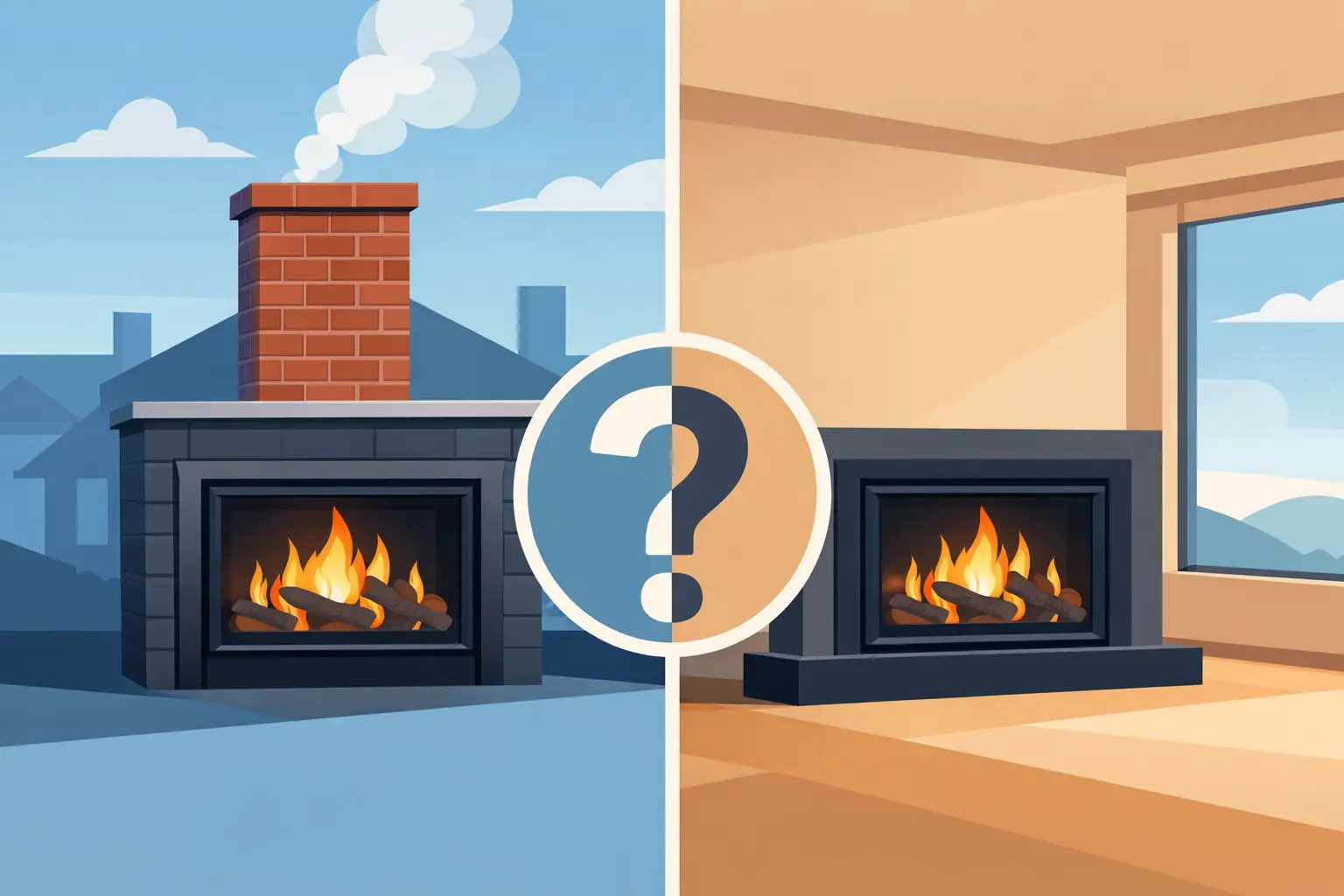
If you are asking do I need a chimney for a gas fire, the short answer is no – but it does depend on the type of fire you choose. That is where many homeowners get caught out. Some gas fires do need a working chimney or flue, while others are designed specifically for homes without one.
That matters whether you are updating an older fireplace, renovating a newer property, or simply trying to create a warm focal point in the lounge without taking on unnecessary building work. The right answer comes down to your home, your room layout and the style of fire you want.
Do I need a chimney for a gas fire in every home?
No, not in every home. A traditional inset gas fire will usually need a chimney or suitable flue to take combustion gases safely outside. If you already have a chimney breast and fireplace opening, that can make certain gas fire options more straightforward.
However, many modern gas fires are made for properties with no chimney at all. In homes across the Wirral, Chester and surrounding areas, this is a common question because plenty of newer houses were never built with a chimney in the first place. Others may have had the chimney removed, capped, or left unsuitable for use.
So the better question is not simply whether you need a chimney. It is whether your chosen gas fire needs a safe and suitable way to vent, and what kind of installation your property can accommodate.
The three main types of gas fire
To understand whether a chimney is needed, it helps to know the difference between the main categories.
Conventional flue gas fires
These are the type most people picture first. They are often fitted into an existing fireplace opening and use a class 1 chimney, a class 2 flue, or another appropriate flue system depending on the appliance. The flue carries fumes safely out of the home.
If you have a working chimney, this type of fire may be a very natural fit. It can suit both traditional and contemporary surrounds, and there is still a wide choice of styles available.
The trade-off is that the chimney or flue has to be suitable. If it is damaged, blocked or not compatible with the fire, extra work may be needed before installation can go ahead.
Balanced flue gas fires
A balanced flue gas fire does not need a chimney, but it does need an outside wall. These fires are glass-fronted and use a pipe through the external wall to draw in fresh air and expel fumes. Because the appliance is room sealed, they are a very practical option for homes without a chimney.
This type of fire is popular in modern houses and extensions where there is no existing flue. It can also be a good choice if you want a neat, efficient fire with a clean fitted look.
The main limitation is location. If the fire is going on an internal wall rather than an external one, a balanced flue model may not be suitable.
Flueless gas fires
Flueless gas fires also do not need a chimney. Instead, they use a catalytic converter system to clean the combustion gases so the fire can operate without a traditional flue.
They can work well in the right room and offer flexibility where chimney and outside wall options are limited. That said, they are not a one-size-fits-all answer. Room size, ventilation requirements and the intended use of the space all need to be checked carefully.
Some homeowners like the installation flexibility, while others prefer a fire that vents directly outside. It is very much a case of choosing what suits the property and the customer rather than looking for one universal best option.
What if you already have a chimney?
If your home already has a chimney, that does not automatically mean every gas fire will be suitable, and it does not mean you have to choose a chimney-dependent model either.
Older chimneys can vary a lot in condition. Some are perfectly usable with the right appliance. Others may need lining or remedial work. There are also cases where a chimney exists but the customer prefers a balanced flue or another style for efficiency, design or layout reasons.
This is why a proper survey matters. From the outside, a fireplace opening can look ready to go, but the condition and size of the flue behind it are what really determine what can be installed safely.
If you do not have a chimney, what are your options?
Plenty of options are still available. In fact, not having a chimney is no longer the obstacle it once was.
Balanced flue fires are often the first thing to consider if the fire will be fitted to an external wall. They offer a real flame gas fire without the need for an existing chimney breast. There are also hole-in-the-wall and contemporary landscape designs that work especially well in modern interiors.
Flueless gas fires may also be possible, subject to the room meeting the correct requirements. For some homes, an electric fire is worth considering too, particularly where installation flexibility and minimal building work are the priority.
The best route depends on whether your focus is realistic flame effect, heat output, room layout, installation cost or a particular finished look.
Why the answer is not just yes or no
When people ask do I need a chimney for a gas fire, they are usually trying to get to three practical concerns at once. Will it fit in my home? Will it be safe? And will it look the way I want it to look?
Those questions are tied together. A fire might suit the style you want but not the wall position. Another might work technically but require extra ventilation or a different surround. A third might be the simplest install but not give you the heat or visual impact you had in mind.
That is why good advice should take in the whole picture rather than just the appliance brochure.
Safety and installation matter more than the label
Whatever type of gas fire you choose, it must be installed correctly and checked for suitability by a qualified professional. Gas fires are not a product to guess with, especially when flues, ventilation and building regulations come into the conversation.
A proper installation will consider the fire itself, the gas supply, the fireplace or wall construction, hearth requirements where relevant, flue route, clearances and the room setting. Even a fire that does not need a chimney still needs the right conditions to operate safely.
This is also where homeowners can save themselves stress. Choosing a fire from a showroom with expert guidance is usually far easier than trying to work backwards from an online product page and hoping it will suit the property.
Choosing the right gas fire for your room
The visual side matters just as much as the technical side. For some homes, a classic inset gas fire with a surround and hearth is exactly right. For others, a slimline balanced flue fire creates a cleaner, more contemporary finish.
Heat output also needs to match the room. Bigger is not always better. A fire that overpowers the space can be just as disappointing as one that does not provide enough warmth. The position of the fire, the room size, insulation levels and how you use the room all play a part.
That is often why a showroom visit helps. Seeing fires in person gives you a much clearer sense of scale, finish and flame picture, and it makes it easier to compare options that would all sound similar on paper.
The best next step if you are unsure
If you are not sure whether your home needs a chimney for a gas fire, the most useful next step is to start with the property rather than the product. Find out what kind of chimney, flue or wall position you have available, then narrow the choice from there.
At Wirral Fires, this is exactly the sort of question we help with every day. Some customers come in knowing the brand and model they want. Others simply know they want a gas fire and need honest advice on what will work in their home. Both approaches are fine.
A gas fire should feel like a worthwhile improvement, not a complicated puzzle. Once the right type is matched to the room and installed properly, the decision becomes much clearer – and so does the finished result.
If you are weighing up your options, it is always better to ask a few practical questions at the start than to fall for a fire that looks perfect but is wrong for the house.