

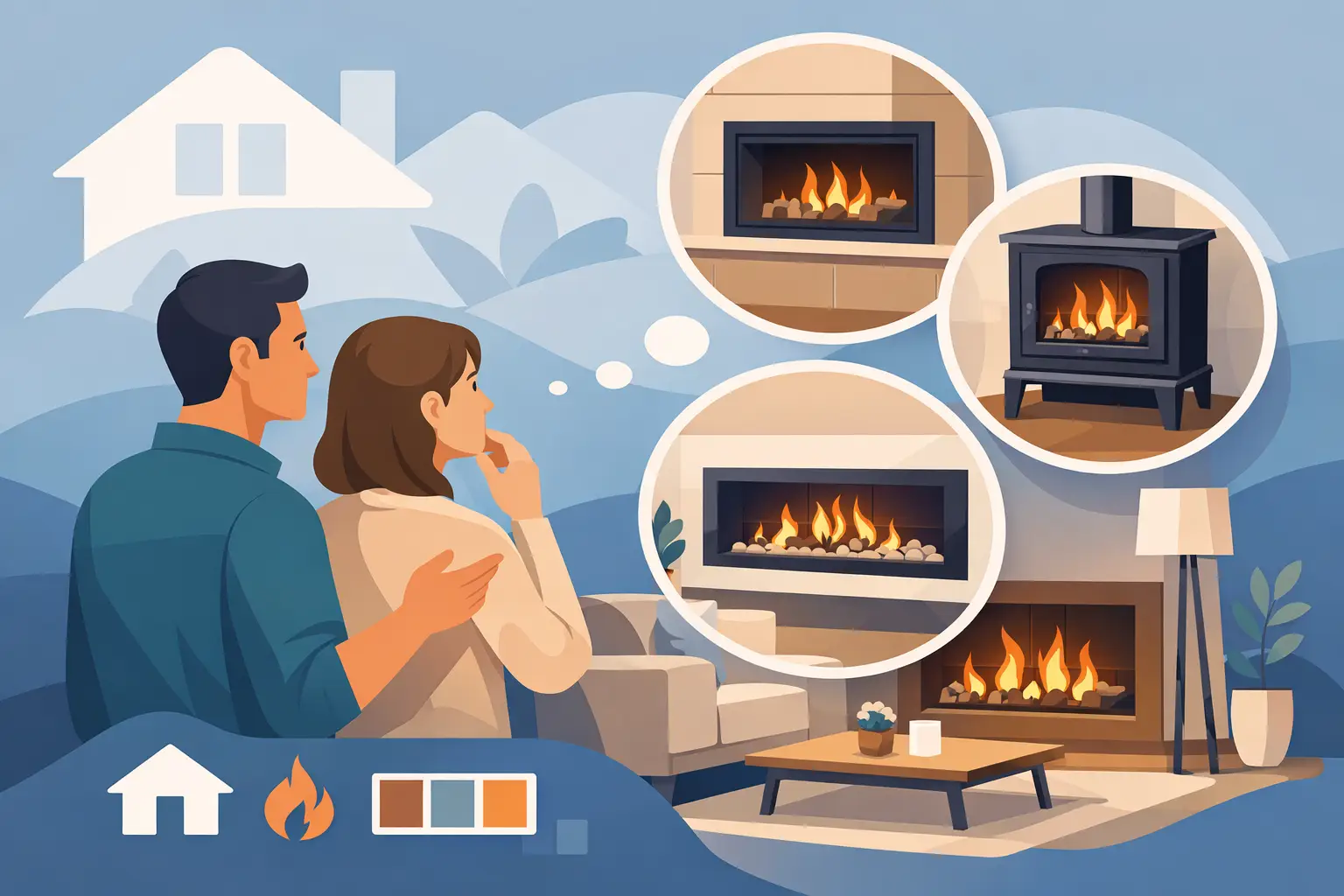
A gas fire can completely change a room, but only if it suits the space properly. If you are wondering how to choose a gas fire, the best place to start is not colour or brand – it is how the fire will work in your home, how much heat you actually need, and what kind of installation is possible.
This is one of those purchases where the nicest-looking option is not always the right one. A fire that looks perfect in a brochure may produce too much heat for a small lounge, require a flue you do not have, or need a surround and hearth that were never part of your plan. Getting it right means balancing appearance, performance and practical fitting requirements.
Start with the room, not the fire
Most homeowners begin by picturing the finished look. That makes sense, because a gas fire is often the focal point of the room. But before deciding on a traditional inset fire, a modern hole-in-the-wall design or a stove-style gas fire, it helps to look at the room itself.
Room size matters because heat output needs to match the space. A larger room with high ceilings may need a stronger output to feel comfortable, while a smaller sitting room can quickly become too warm if the fire is overpowered. More heat is not always better. In many homes, especially newer or better insulated ones, an overly powerful fire can make the room uncomfortable and leave you turning it down all the time.
The layout matters too. If the chimney breast is shallow, if the room is open plan, or if there are furniture restrictions around the fireplace opening, those details will affect what type of fire is suitable. This is why seeing appliances in person and talking through the room setup can save a lot of guesswork.
How to choose a gas fire based on your chimney or flue
One of the biggest deciding factors is whether your property has a chimney, a flue, or neither. This shapes the options available more than most people expect.
If you have a conventional chimney, you may be able to choose from a wide range of inset gas fires, gas stoves and higher-efficiency models. Even then, the chimney condition still needs checking. Older chimneys may require lining, and in some cases the opening or recess needs adapting to suit the appliance.
If you do not have a chimney, that does not rule out a gas fire. Balanced flue gas fires are often a strong option for homes without a traditional chimney, as they use a sealed system through an outside wall. They can be highly efficient and offer a clean, contemporary finish. The main limitation is that the fire usually needs to be positioned on a suitable external wall.
Flueless gas fires are another possibility in some homes. These can work well where other flue options are limited, but they have specific ventilation requirements and are not right for every property or every customer. This is one of those areas where honest advice matters, because what is technically possible is not always what feels best in everyday use.
Think carefully about heat output and efficiency
When customers ask how to choose a gas fire, they often mean how to choose one that feels worth the money month after month. That usually comes down to heat output and efficiency.
Heat output is measured in kilowatts, and the right figure depends on the room. A modestly sized living room may only need a lower output, while a larger, older room with more heat loss may need more support. It is worth thinking about how you use the room as well. If the gas fire is intended as a secondary heat source and central heating does most of the work, you may not need the strongest model available.
Efficiency is about how much of the heat produced actually stays in the room rather than disappearing up the chimney. Open-fronted gas fires can offer a classic appearance, but glass-fronted models are usually more efficient. That means better heat retention and, in many cases, better running performance. There is sometimes a trade-off here between traditional appearance and fuel efficiency, so it is worth deciding which matters more to you.
Choose a style that suits the house
The fire needs to work visually with the room, but also with the age and character of the property. In a period home, a traditional living flame gas fire with a mantel and hearth may feel completely at home. In a newer extension or renovated open-plan space, a more minimal hole-in-the-wall fire or landscape design may fit better.
This is where many homeowners feel torn between what they like and what suits the room. Our advice is usually simple: choose something you will still be happy looking at in five or ten years. A fireplace is not like a cushion or a lamp. It is a feature that tends to stay in place for a long time, so going too trend-led can date more quickly than people expect.
Materials also make a difference. Chrome, black, cast iron, limestone and timber all create a different feel. Even the flame picture matters. Some people want a crisp modern look, while others want a deeper fuel bed and a more traditional flame effect. Neither is right or wrong – it depends on the room and your own taste.
Do not overlook the controls
Controls are easy to ignore when you are focused on style, but they make a real difference in daily use. Some gas fires use manual controls, others have a slide control, and many modern models can be operated by remote.
If ease of use is important, particularly for older homeowners or anyone with mobility concerns, remote control can be a very worthwhile feature. It can also make the fire feel much more convenient as a regular part of the room rather than something you only use occasionally.
The same goes for flame and heat settings. A model with flexible control gives you more choice throughout the year. You might want full heat on a cold January evening, but only the look of the flame on a milder autumn night.
Installation matters as much as the appliance
A well-chosen gas fire still depends on proper fitting. Safe installation is not an extra – it is essential. The appliance has to suit the property, comply with current regulations and be installed correctly by a qualified Gas Safe engineer.
This is also why it helps to think beyond the fire itself. You may need a new surround, alterations to the opening, a hearth upgrade, a chimney check, or additional finishing work to achieve the final look. For some customers, a complete package makes the whole process simpler because the design, supply and fitting are considered together rather than separately.
Tidy workmanship counts too. A fireplace sits in one of the most visible parts of the home, so the finishing details matter. The best result is not just a fire that works well, but one that looks as though it truly belongs in the room.
Budget honestly – and look at overall value
Prices can vary widely depending on the appliance, the type of flue, the finish around it and the work involved. It is tempting to compare fires on ticket price alone, but that rarely tells the full story.
A cheaper fire may become less attractive if it is less efficient, offers fewer control options or requires additional building work. Equally, a more premium model may prove better value if it gives stronger performance, lower running waste and a finish you are much happier with long term.
If you are replacing an existing fire, some of the infrastructure may already be in place, which can help. If this is a new feature in a room that has never had one before, the project may involve more than expected. Clear advice at the start helps avoid unpleasant surprises later.
Why seeing gas fires in person helps
Online research is useful, but gas fires are one of those products that make more sense when you see them working. Flame depth, trim finishes, proportions and control options are hard to judge on a screen. A model that looks ideal in a photograph can feel completely different in real life.
That is one reason many homeowners still prefer a showroom visit. It gives you the chance to compare styles side by side, ask practical questions and get straightforward guidance based on your room, your chimney setup and your budget. For a considered purchase like this, reassurance matters.
At Wirral Fires, that is often where people feel the process becomes simpler. Instead of trying to decode technical details on their own, they can look at the options with someone who understands both the appliance and the installation.
The best choice is the one that fits your home properly
There is no single answer to how to choose a gas fire because the right option depends on your property, your heating needs and the look you want to create. The smartest choice is usually not the biggest, the cheapest or the most fashionable. It is the one that suits the room, works safely and gives you the balance of warmth, efficiency and style you will still appreciate long after installation day.
If you are unsure, that is perfectly normal. A good gas fire should feel like a confident decision, not a rushed one, and a bit of expert guidance at the start can make the whole process much easier.