

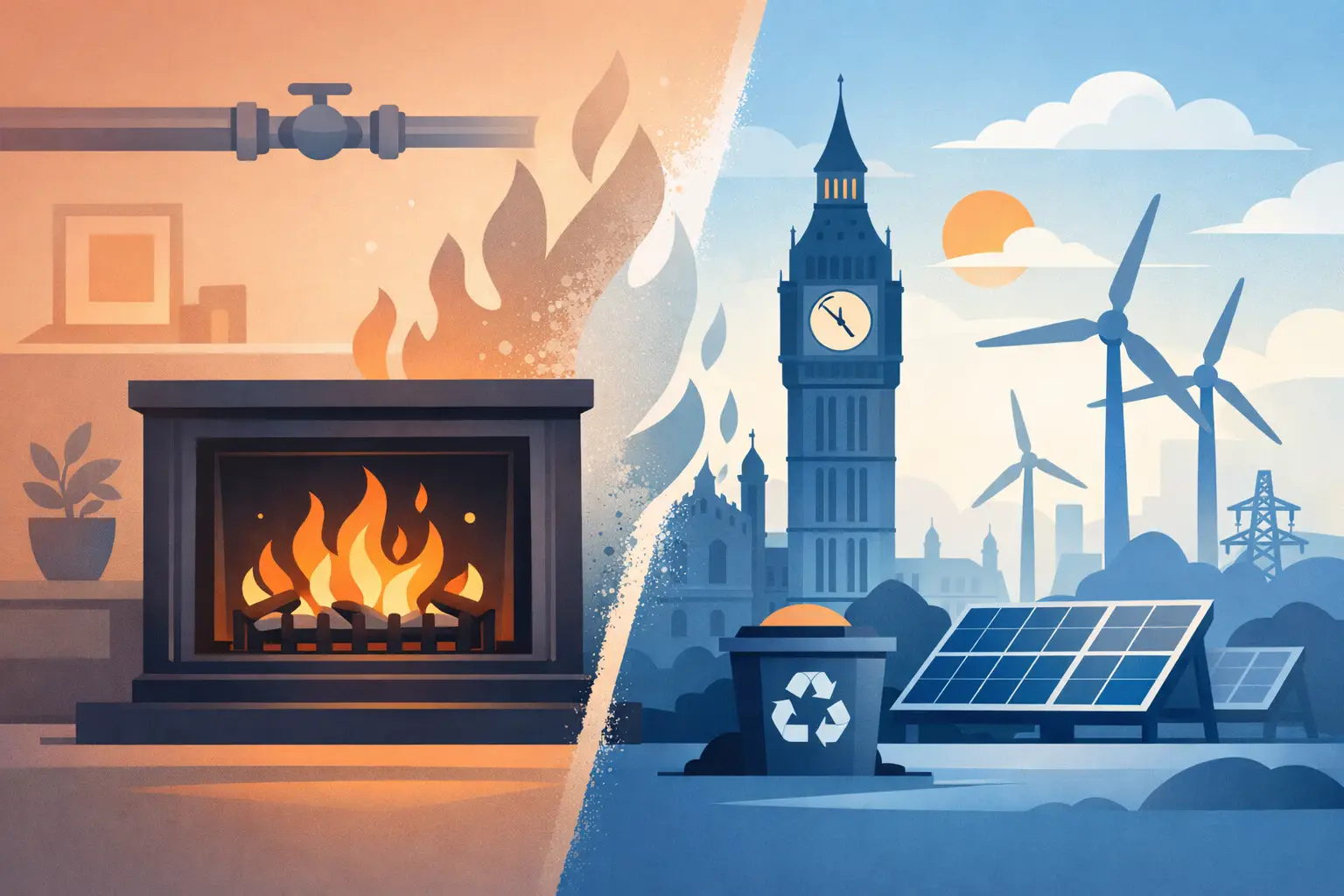
A lot of homeowners ask us the same question when they start updating a living room or replacing an older appliance – are gas fires being phased out, and is it still sensible to buy one now? It is a fair concern. Energy rules are changing, heating choices are under more scrutiny, and nobody wants to invest in the wrong fire for their home.
The short answer is no, gas fires are not being universally phased out in the way many people fear. But the longer answer matters more. Some older appliances have fallen out of favour, new-build rules are changing, and efficiency expectations are higher than they once were. That means the right gas fire in the right property can still be a very good choice, while other setups may be less suitable than they used to be.
Are gas fires being phased out or just changing?
This is where a lot of the confusion comes from. Headlines about low-carbon heating and the future of gas often get taken to mean that every gas appliance is about to disappear. In reality, the picture is more mixed.
There is a clear policy push in the UK towards reducing reliance on fossil fuels over time, especially for whole-home heating. That has led to more attention on heat pumps, insulation upgrades and lower-emission systems. It has also affected how people think about gas boilers, hobs and fires. However, that does not mean existing gas fires are suddenly banned, or that homeowners cannot replace an old gas fire with a newer one where it is appropriate.
What is changing is the direction of travel. New homes are increasingly being designed without mains gas connections, and regulations tend to favour better efficiency and lower emissions. For homeowners in existing properties, though, gas fires remain available, widely installed and, in many homes, entirely practical.
What the rules mean for existing homes
If you already have a gas fire, there is no blanket requirement to remove it simply because policy is evolving. In most cases, you can continue using it provided it is safe, properly maintained and suitable for the flue and room it serves.
If your current fire is old, inefficient or unreliable, replacement is often the real issue rather than removal. Many older open-fronted models are less efficient than modern glass-fronted or high-efficiency gas fires. So when people ask whether gas fires are being phased out, what they are often noticing is that the market itself has moved on. Manufacturers and installers naturally favour appliances that perform better, look smarter and meet current standards.
For many households, especially those wanting dependable heat in a main living space, a modern gas fire can still make excellent sense. It offers instant control, consistent warmth and a real flame effect without the fuel storage, lighting process and maintenance that come with solid fuel.
Where gas fires may become less common
Gas fires are likely to become less common in some settings, but not for every homeowner at the same pace.
New-build properties are one obvious example. As building standards tighten and developers move away from gas infrastructure, electric options are often the easier fit. If a home is built around all-electric heating from the start, a gas fire is unlikely to be part of the plan.
Some homeowners are also choosing electric fires during renovations because they want a simpler installation, more flexibility in room design or no need for a chimney or gas supply in that part of the house. In very airtight modern homes, those practical factors can tip the balance.
That does not make gas obsolete. It simply means the decision depends more on the property, the desired look, the available flue options and how the room is actually used.
Are gas fires still worth buying?
For plenty of homes, yes. The key is choosing the right appliance rather than assuming every gas fire is the same.
A good modern gas fire can be an efficient secondary heat source and a strong focal point in the room. Many customers still prefer the warmth and appearance of a live flame, and they want something that works quickly without waiting for a stove to come up to temperature. If you use your lounge mainly in the evenings, a gas fire can be a very practical way to heat that space without necessarily heating the whole house more than needed.
There are trade-offs, of course. Gas is a fossil fuel, so if your main priority is reducing carbon impact as far as possible, you may lean towards electric. Running costs also depend on energy prices, appliance efficiency and how often the fire is used. That is why broad statements rarely help. One home may suit a gas inset fire perfectly, while another may be better with an electric suite or a stove package.
Choosing a gas fire with the future in mind
If you are considering a new gas fire, the best approach is to think beyond the question of whether gas fires are being phased out and focus on suitability.
Start with the room itself. Size, insulation levels and how often you use the space all matter. A fire that looks attractive in a brochure still needs to provide the right heat output for the room. Too little heat and it feels disappointing. Too much and the room quickly becomes uncomfortable.
The chimney or flue arrangement is just as important. Some homes are suited to conventional flued gas fires, others to balanced flue or flueless models, and some are not practical for gas at all without significant alteration. This is where proper advice saves time and expense.
Style also plays a part. Many homeowners are not just replacing heat – they are updating the whole focal point of the room. Hole-in-the-wall fires, contemporary glass-fronted models and more traditional inset designs all create a different feel. Choosing well means balancing appearance, performance and installation requirements rather than chasing a trend.
Gas fire or electric fire?
This is often the real decision. If you are weighing up a gas fire against an electric one, there is no single winner for every home.
Gas tends to appeal to people who want stronger room heat and the character of a real flame. It can be an excellent option where there is already a suitable gas supply and flue route, and where the fire will be used regularly enough to justify the installation.
Electric usually appeals to those who want easier fitting, fewer building constraints and a broad choice of styles. It is often ideal for flats, newer homes, media walls and rooms where adding a flue would be difficult or costly.
The best choice often comes down to how you live. If the fire is mainly about ambience with occasional top-up heat, electric may be ideal. If you want a fire that contributes more noticeably to the room’s warmth and gives that traditional flame presence, gas still has a strong case.
Safety, servicing and compliance still matter
Whatever the wider policy picture, gas appliances must always be treated seriously. A gas fire should be supplied and fitted correctly, with attention to ventilation, flue performance, clearances and manufacturer guidance. Ongoing servicing is just as important.
This is another reason why the idea of gas fires being phased out can be misleading. In day-to-day terms, the more relevant question is often whether your chosen appliance will be safely and properly installed in your particular home. A modern, correctly specified gas fire fitted by a qualified professional is very different from trying to keep an unsuitable older appliance going past its best.
For homeowners, peace of mind counts for a lot. A considered purchase like this is not just about what looks good in the showroom. It is about knowing the appliance is right for the room, fitted to current standards and likely to serve you well for years.
So, are gas fires being phased out for good?
Not across the board, no. They are still a valid option in many existing homes across the UK, and for the right property they remain an attractive, reliable and stylish heating choice. What is happening is a gradual shift in the wider heating market, with more focus on efficiency, lower emissions and alternatives for certain types of home.
That means the old question of “can I still have a gas fire?” has become a more useful question: “is a gas fire the right choice for my home?” In many cases, the answer is still yes. In others, electric or another solution may be the better fit.
If you are replacing an old fire, renovating a chimney breast or planning a new focal point in your lounge, the most helpful step is to look at real options in person and get straightforward advice based on your home, not just the headlines. A good fireplace choice should suit the room, the property and the way you actually live with it.